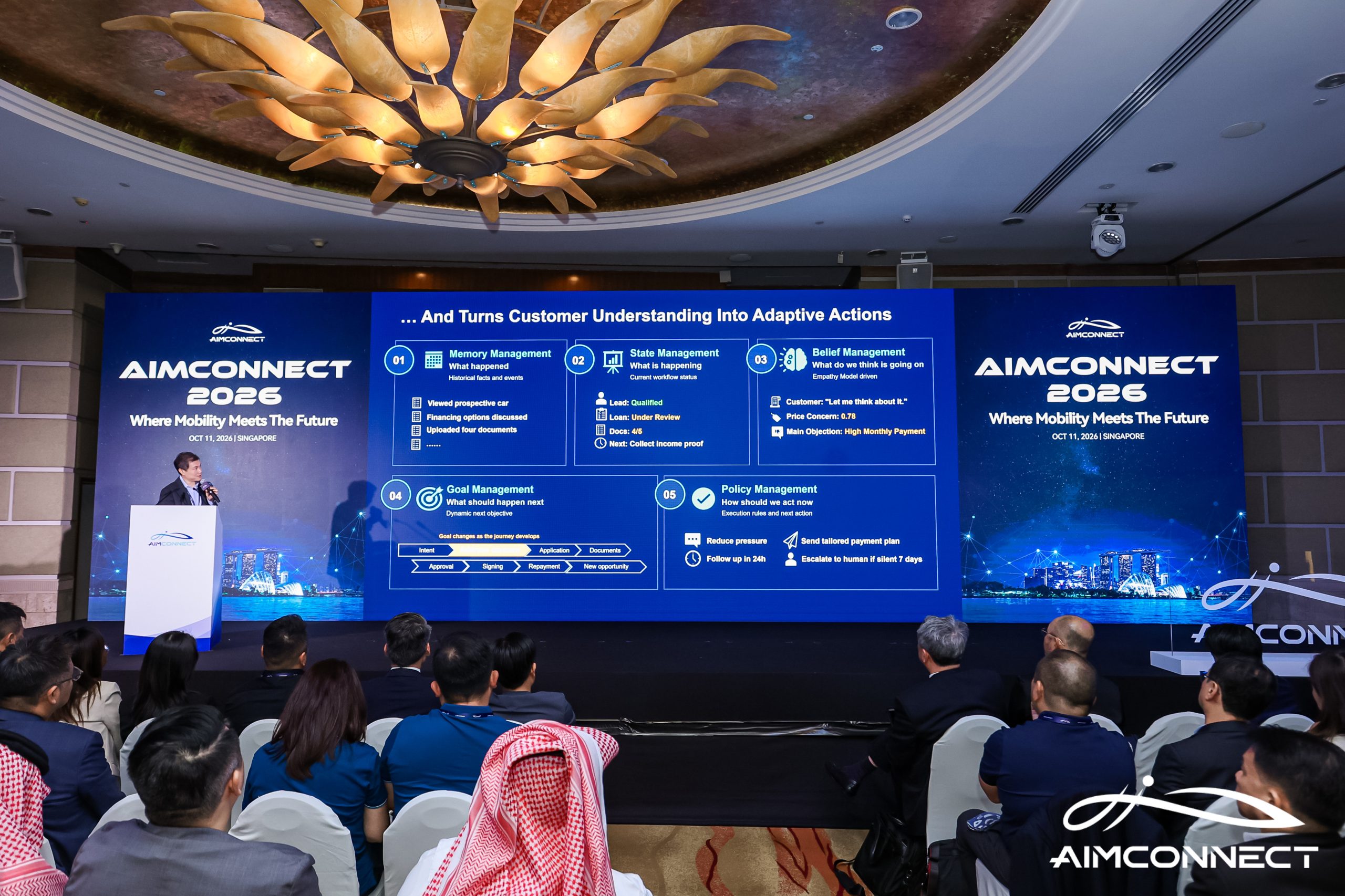
As AI takes on more of the automotive journey, industry leaders at AIMCONNECT 2026 considered what it will take to connect the customer experience while keeping financial decisions accountable.
Industry leaders at AIMCONNECT 2026 discussed the future of mobility, finance and cross-industry collaboration.
Buying a car involves more than choosing a vehicle. Customers move between research, dealerships and financing, often crossing systems that were never designed to work together. As AI becomes part of more of those steps, the question for the automotive industry is how to make the journey easier without weakening the controls on which customers and financial institutions depend.
That question ran through AIMCONNECT 2026, held on 11 October at Shangri-La Rasa Sentosa, Singapore. Organised by X Star Technology and Aimotion under the theme “Where Mobility Meets the Future”, the forum drew representatives from more than 100 automotive organisations, including OEMs and dealerships, over 60 financial institutions and more than 20 technology organisations. The mix reflected an increasingly shared agenda across mobility, finance and technology.
The programme opened with welcome addresses from Tin Pei Ling, Member of Parliament, and Datuk Tony Khor Chong Boon, President of the Federation of Motor and Credit Companies Associations of Malaysia. Two keynotes, three industry panels and live technology showcases followed.
Where the customer journey breaks down
A vehicle purchase may look like one journey to the customer, but behind the scenes it brings together carmakers, dealers, financiers and technology providers. Each has a role and its own information. The difficult part is what happens between them: the handovers, repeated steps and gaps in visibility that can slow a deal down.
Technology demonstrations offered a view of how some of those gaps might be addressed. X Star Technology (Xport and AI capabilities), Aimotion, MStar, MK.X and ai Wingman
spanning dealership operations, financing, marketing, mobility and customer engagement.
As AI gains autonomy, trust becomes a design question
Shawn Yang, Chief Executive Officer of X Star Technology, brought the question of trust into focus in his keynote, “The Next Mobility Economy: Intelligence, Connection, Trust”. He set out three priorities for a connected automotive ecosystem: more intelligent engagement and financing, better connections between participants, and trust embedded in the systems supporting both.
“AI can transform every moment of this journey, but only if customers and institutions alike can rely on its integrity,” Yang said. “In auto finance, a single flawed decision risks customer harm and regulatory non-compliance. For AI to operate across the customer journey with true autonomy, trust cannot be an afterthought; it must be engineered into the architecture from day one.”
His point went beyond the decisions made by any one organisation. “Customers are not lost in one stage. They are lost to the friction between the stages,” Yang said. Better technology within a dealership or a financial institution can help, but the experience still depends on how well one stage connects to the next.
Putting boundaries around autonomous systems
Yang used X Star Technology’s Harness framework to illustrate what governance could look like as AI systems take on more responsibility. Its three elements cover human collaboration and intervention, boundaries and escalation for AI agents, and data traceability and compliance. The underlying issue is how to give technology more room to act while retaining clear lines of accountability.
Michael Jia, Chief Technology Officer of X Star Technology, put it succinctly: “The more autonomy you give an AI agent, the clearer its boundaries need to be.”
For automotive businesses and financial institutions, the principle has implications beyond a particular product or platform. As systems become more capable, organisations will need to know who remains responsible, how decisions can be traced and when a person should step in.
What better-connected finance could look like
The same themes surfaced in “Building a Connected Auto Finance Ecosystem”, a panel moderated by Zhang Peng, Founder and Chief Executive Officer of MStar. The speakers were Matthew Duncan of JWT Bespoke, Samuel Fischer of Deutsche Bank, Fumikazu Kitagawa of Deloitte Southeast Asia and Alan Crookes, Chairman of The CEO Circle and former Chief Executive Officer of BMW Group Financial Services for Asia Pacific.
The panel examined how richer information can help assess creditworthiness while keeping financing clear and manageable for customers. Access to more data may improve a decision, but participants also need to consider how that data is used, explained and protected.
“Customers increasingly expect financing to be as seamless and straightforward as the digital services they use every day,” Matthew Duncan said. “Meeting these expectations while maintaining sound risk management requires closer collaboration between dealers, financial institutions and technology providers, supported by effective data sharing and transparency in how customer information is used. AIMCONNECT provided a platform for these stakeholders to exchange perspectives and explore how the industry can move forward together.”
An audience poll suggested that connectivity was also front of mind in the room. Asked what would most improve the automotive financing journey, 38% chose better connectivity across institutions. Stronger infrastructure to capture and analyse data followed at 28%, while 18% selected client centricity and 16% prioritised greater consumer protection without stifling innovation.
The questions that remain after the event
Taken together, the sessions at AIMCONNECT 2026 pointed to a common tension. Customers want a simpler path from choosing a vehicle to arranging finance, while the industry must preserve the checks and accountability behind each decision. The keynote’s focus on intelligence, connection and trust gave those competing demands a shared frame.
The future of ownership is also far from settled. In a separate audience poll, 54% anticipated that consumers would prefer flexible mobility options in ten years, compared with 46% who expected car ownership to remain the preferred choice. The close split suggests that businesses may need to support different ways of accessing mobility rather than plan around a single model.
What happens next will depend partly on technology, but also on whether dealers, manufacturers, financial institutions and technology providers can make their systems and practices work together. The opportunity is a more connected automotive journey, with trust built into the way it operates.
For more information, visit https://event.aimconnect.net/
https://www.linkedin.com/company/aimconnectlive/
About AIMCONNECT 2026
AIMCONNECT 2026 brings together dealers, OEMs, financiers, technology innovators and industry decision-makers through dialogue, thought leadership and live technology showcases, exploring how emerging technologies are reshaping automotive commerce and mobility.